How to Make AI UGC Video Ads Without Hiring Actors (Small Business Walkthrough)
This post contains affiliate links; I may earn a commission at no extra cost to you.
AI disclosure: this guide was drafted with help from AI writing tools and reviewed and edited by PickSavvy Lab. Product details come from the vendor's official sales page.
AI UGC video ads without actors are short, phone-style ads where an AI-generated presenter talks about your product the way a person would on TikTok or Reels. For a small business, the appeal is obvious: no casting, no filming day, no reshoots when you want a new hook. The catch is just as clear. An AI presenter can feel fake, and a fake-feeling ad, or a misleading one, does more harm than no ad.
This walkthrough covers the parts that decide whether these ads work: picking the right UGC format, writing a short script, planning the shots, labeling AI honestly and exporting for each feed. Near the end we look at one tool, AIDirectors Premium, using only what its sales page says (as checked Nov 8, 2026). We haven't tested it hands-on, so we describe its stated features and limits, not results.
What "UGC-style" means, and why it works
UGC means user-generated content: videos that look like a normal person filmed them on a phone. UGC-style ads copy that look on purpose. They're vertical, casual, talk straight to camera and get to the point fast.
They work because they don't look like ads at first glance. That's also why honesty matters more here than in a polished commercial. A viewer may assume the person is a real customer. With an AI presenter, they aren't, so the ad has to avoid implying they are.
Step 1: Pick a UGC format that doesn't need a real customer
Some UGC formats depend on a real person's experience. Others don't. With an AI presenter, choose from the second group:
- The explainer. "Here's what this does and who it's for." The presenter describes the product, like a shop assistant would.
- The problem-solver. "If your coffee's cold by 10am, this is why people buy this mug." It names a problem and shows the product as one answer.
- The "3 things to know." Three quick facts about the product, one per scene.
- The unboxing walk-through. What's in the box, using your real product photos.
- The FAQ answer. One common customer question answered in 20 seconds.
Avoid the testimonial format ("I used this for a month and…") with an AI presenter. An AI person has no experience to report, so a first-person review from them would be a made-up testimonial. If you want testimonials, use quotes from real customers, with permission, shown as text on screen.
Step 2: Write a five-line UGC script
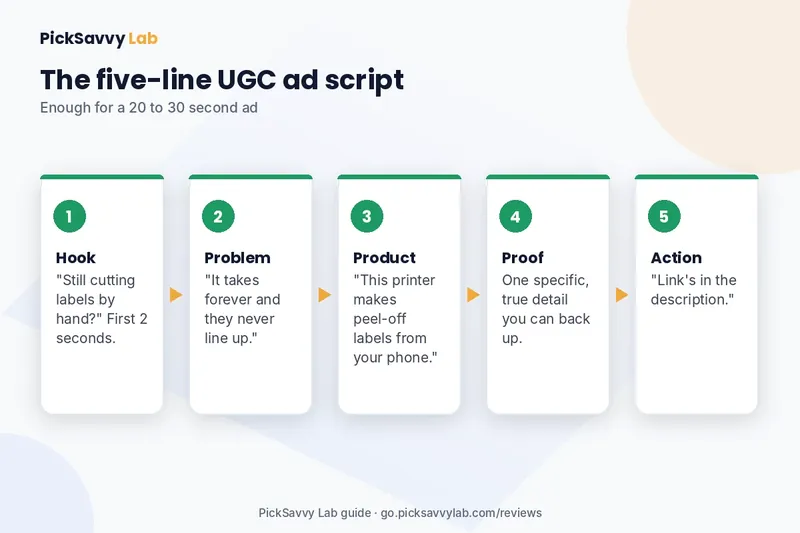
Short UGC-style ads usually run 15 to 30 seconds. Five lines are enough:
- Hook (first 2 seconds). A question or a surprising detail. "Still cutting labels by hand?"
- Problem. One sentence the viewer recognizes. "It takes forever and they never line up."
- Product. What it is, in plain words. "This printer makes peel-off labels from your phone."
- Proof or feature. One specific, true detail. "It prints on rolls up to 2 inches wide."
- Action. One clear next step. "Link's in the description."
Write it the way people talk: short sentences, contractions, no slogans. Then write three different hooks for the same script. The hook decides whether anyone hears line two, and swapping a hook is far cheaper than making a new ad.
Only use claims you can prove for your product. If you're not sure a result is true for every buyer, describe the feature instead of promising the result.
Step 3: Plan the shots around your real product
AI is good at the presenter, the voice and the captions. It shouldn't invent what your product looks like. A simple five-scene plan:
| Scene | What's on screen | Who makes it |
|---|---|---|
| 1. Hook | Presenter says the hook, big caption on screen | AI presenter |
| 2. Problem | Presenter, or a simple visual of the problem | AI presenter or stock |
| 3. Product | Your real product photo or clip, close-up | You (real images) |
| 4. Proof | Feature shown in close-up, short caption | You (real images) |
| 5. Action | Presenter says the next step, caption repeats it | AI presenter |
The rule underneath it: the presenter can be AI; the product can't be. Use your own photos or footage so the buyer gets what they saw.
For more on what to film versus what to generate, see our guide on how to make product videos with AI.
Step 4: Make it work with the sound off
Many people scroll with the sound off, so the ad has to make sense silently:
- Burn in captions, or turn on auto-captions and fix any mistakes.
- Put the hook as large text on the first frame.
- Keep one idea per caption, five to seven words.
- Keep text in the middle of the vertical frame, away from the app's buttons at the top and bottom.
Watch your draft once with the sound off. If you can't tell what's being sold within five seconds, change scene 1 or 3.
Step 5: Label it honestly
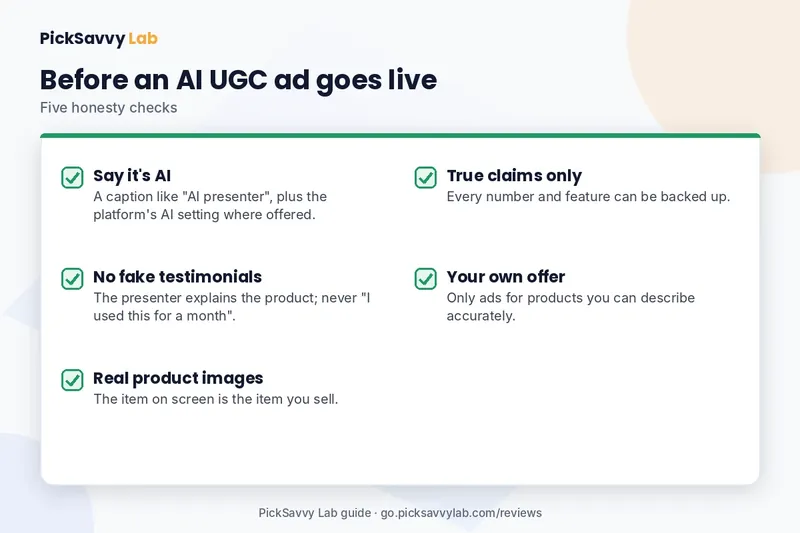
Before you publish, run through this checklist:
- [ ] Say it's AI. A short caption like "AI presenter" or a line in the post text is enough. Several big platforms also ask creators to disclose realistic AI-generated people when uploading; check each platform's current setting.
- [ ] No fake testimonials. The presenter explains the product; they don't claim to have used it.
- [ ] Real product images. The item shown is the item sold.
- [ ] True claims only. Every number and feature in the script is something you can back up.
- [ ] Your own offer. Only make ads for products you can describe accurately.
This isn't only about rules. Viewers who find out later that a "customer" was AI tend to stop trusting the brand. Telling them up front costs very little.
Step 6: Export for every feed
Make the vertical version first if social is your main channel:
- 9:16 for TikTok, Reels, Shorts and Stories.
- 1:1 for square feed placements.
- 16:9 for YouTube, websites and product pages.
Keep the same script across sizes and only move captions so they stay inside the frame.
Where AIDirectors Premium fits
If Steps 2 to 6 sound like four separate tools (script writer, AI presenter, voice and editor), that's the job AIDirectors Premium says it does in one app. According to its sales page, as checked Nov 8, 2026:
- Scripts from a product image or link. An idea generator suggests 3 to 5 video concepts and 3 to 5 script variations per campaign, with tone and style settings.
- AI spokespersons. A library of AI-generated characters, or a custom avatar from a photo you upload.
- Voice and lip-sync. Automated voiceover and lip-sync, with ElevenLabs integration and, in the page's words, "hundreds of voice styles, accents, and languages."
- Storyboard and editing. Scene-by-scene storyboards with drag-and-drop editing, text overlays, captions and background music.
- Export. MP4 and MOV in multiple resolutions, in 9:16, 16:9 and 1:1.
That lines up with this walkthrough: script (Step 2), presenter and scenes (Step 3), captions (Step 4) and multi-size export (Step 6). Step 5, honest labeling, is still your job in any tool. The sales page's FAQ says viewers won't know it's AI unless you tell them; we'd recommend telling them anyway.
What to weigh before buying
What stands out on the sales page
- One app for script, presenter, voice, music and export.
- Custom avatars from your own photo.
- All three main aspect ratios.
- One-time price with a commercial license; the FAQ says "Zero monthly fees on commercial license."
What to check first
- Usage limits are stated two ways. The plan lists 100 video ad campaigns and 5 active projects, while the FAQ says 5 campaigns a month, unlimited on an upgrade. Check the terms at checkout and test against them early.
- The guarantee is 14 days. Try it on a real product in the first week.
- Upgrades are offered after checkout, and a separate bundle is sold at a yearly price.
- The page includes income talk. We judge it only as a video tool and make no income claims.
- The page suggests promoting products you don't own. Our advice is the same as Step 5: only make ads for products you can describe accurately.
Who should pass
If you have no product or offer to promote yet, if you'd rather not use AI presenters in your marketing, or if you need high volume on the base plan, it isn't a good fit. It also won't replace real images of your product.
Price
As listed on the sales page when checked Nov 8, 2026: $37 one-time for the commercial license, shown as reduced from $97. The page says the price goes up soon, so check the checkout for the final amount.
FAQ
Can I make UGC ads without hiring actors or creators? Yes. AI video tools can generate a presenter, voice and captions. You still need a clear script and real images of your product.
Do I have to say an AI presenter isn't real? Several platforms ask you to disclose realistic AI-generated people, and it's the honest choice either way. Never present an AI presenter as a real customer.
How long should an AI UGC ad be? Usually 15 to 30 seconds for TikTok, Reels and Shorts. One idea per ad works best.
Can AI UGC ads use testimonials? Not from the AI presenter. Use real customer quotes, with permission, as on-screen text.
What does AIDirectors Premium cost? Its sales page showed $37 one-time for the commercial license, reduced from $97, when checked Nov 8, 2026. The checkout shows the current price.
Next step
For AIDirectors' full feature list, the usage-limit details and the 14-day guarantee in one place, read our AIDirectors Premium review. To browse every tool we cover, visit the PickSavvy Lab home page.
Whatever tool you choose, start with the five-line script and the honesty checklist. Those two pages do more for an ad than any avatar.
Source: AIDirectors sales page (checked Nov 7 and Nov 8, 2026). Product names belong to their owners. Platform names are mentioned only as places to post.
Free: grab our Holiday Content Kit → https://picksavvylabdigitaltools.systeme.io/holiday-kit
Free: Holiday Content Kit (email required, not an affiliate link)
Affiliate disclosure & privacy policy · About · Free Holiday Content Kit